CAMPO APÍCOLA
Web & Brand Experience
Connecting the authenticity of a traditional business with a digital commerce experience.
Not yet measured
01Project Overview
Campo Apícola is a Colombian brand associated with traditional beekeeping, the sale of hive-derived products, and the communication of the environmental value of bees.
Its digital experience connects the brand identity with product discovery, educational information, and online purchasing options.
The case makes it possible to examine how to translate a specialized productive activity into an accessible and commercially functional digital presence.
02The Challenge
Businesses connected with traditional activities need to communicate both the value of their products and the knowledge and authenticity that distinguish them.
In Campo Apícola's case, the experience needed to make the commercial offering understandable while also conveying its relationship with nature, beekeeping, and the origin of its products.
The design challenge is to balance brand storytelling, consumer education, and commercial navigation.
Design question: How can a story of origin and artisanal production be turned into a digital experience that inspires trust and facilitates purchases?
03My Role
My participation in this project relates to the web experience work I have carried out for Campo Apícola.
The case focuses on decisions about digital presentation, content structure, and discovery and purchasing journeys.
The precise attribution of design, development, configuration, and publication activities should be completed using the project history in order to accurately represent my individual contribution.
04Discovery
The analysis starts from Campo Apícola's value proposition: hive-derived products, traditional production, connection to the territory, and communication of the importance of bees.
The offering spans different categories, so the digital journey should serve both people interested in specific products and visitors who want to learn about the brand.
The design needs considered include:
- Understand what Campo Apícola offers.
- Learn about the business's origins and identity.
- Explore product categories.
- Find information for purchasing or getting in touch.
- Discover content related to beekeeping.
These needs are used as hypotheses for analyzing the product; they are not attributed to documented interviews.
05Design Process
The web experience combines a brand introduction with journeys leading to the commercial offering.
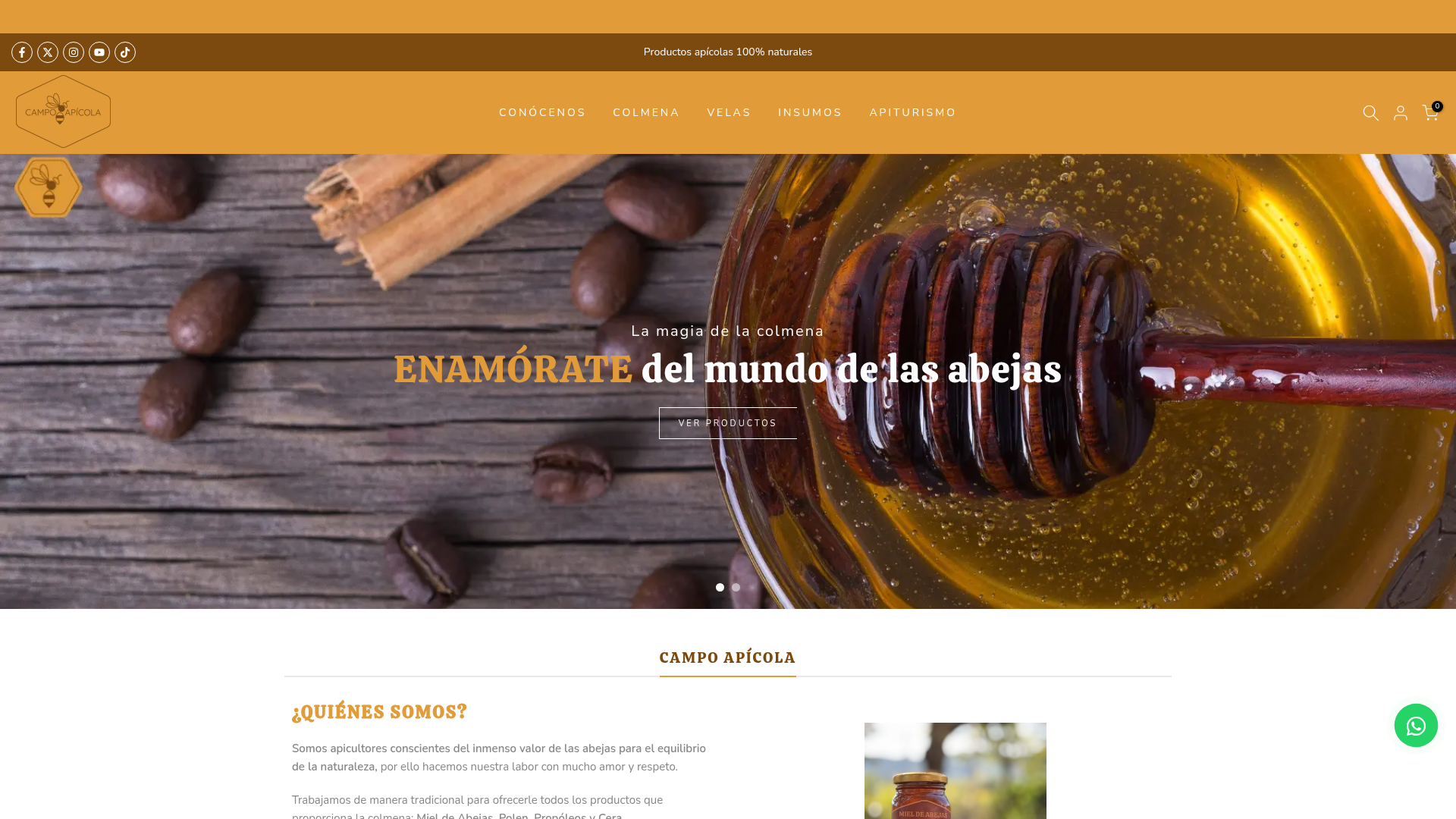
The homepage conveys the world of Campo Apícola through photography, narrative content, and links to products.
The site includes store categories, content about the organization, a visual gallery, and explanations of the purchasing process.
This composition makes it possible to observe how emotional and functional elements are combined within a single experience.
- 01
Brand & origin
- 02
Product categories
- 03
Product information
- 04
Cart
- 05
Order process
Illustrated from the supplied narrative; not an original project artifact.
06Key Design Decisions
1. Give prominence to product origins. Campo Apícola's story provides context and differentiation for the commercial offering.
2. Use images connected to the actual activity. Photographs of products, bees, and beehives help communicate the character of the business.
3. Organize the store into categories. Clear categorization makes it easier to find different types of products.
4. Maintain paths to purchasing and contact. The site includes options to explore products, access the cart, and contact the business.
5. Explain how to place an order. Showing the steps in the process helps reduce uncertainty for first-time buyers.
07The Solution
A public web experience that combines:
- An introduction to the brand and its origins.
- A catalog organized by category.
- Visual and educational content about beekeeping.
- Access to products and the shopping cart.
- Information about the ordering process.
- Business contact options.
- Content related to the activity and the territory.
Project evidence
08How I Used AI
The project can be documented from a web design perspective and, once the actual use of tools is confirmed, examples of AI support for content, architecture, or prototyping can be included.
No specific tasks are attributed to AI without evidence of the tools used.
To turn it into a demonstrable AI-assisted design case, it is important to retrieve actual examples of iterations, interface changes, or content structuring.
09Validation
The public site makes it possible to review journeys such as learning about the brand, exploring categories, viewing products, and proceeding toward checkout.
This review makes it possible to assess observable functional aspects, but does not by itself demonstrate an improvement in usability or conversion.
Recommended metrics for evaluating performance include navigation to categories, product views, cart additions, checkout starts, and completed purchases.
10Outcomes & Learnings
The observable result is a digital presence that brings together brand identity, informational content, and e-commerce.
The main product takeaway is that, for a brand with a meaningful origin story, storytelling can be part of the purchasing journey rather than being limited to an institutional section.
The case also illustrates the importance of designing commercial experiences that connect a brand's authenticity with concrete actions for its customers.
Status: public website. Detailed individual contribution and impact metrics remain to be documented.
Not yet measured
Next project
EFAI →